
By Svitlana Seheda, Researcher.
What does it take for a project to leave behind more than good memories and useful contacts?
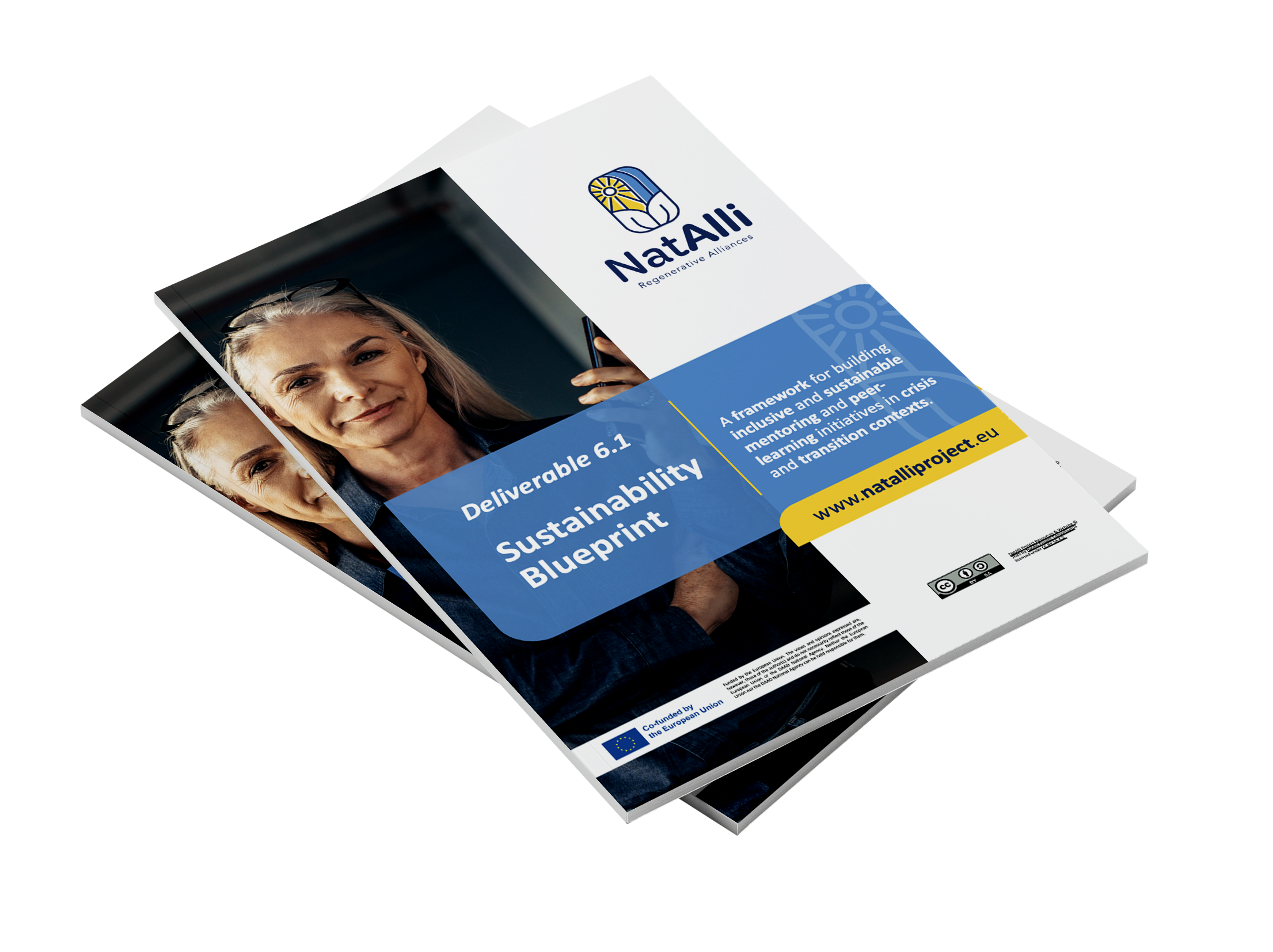
In NatAlli, the answer is now captured in the Sustainability Blueprint. It is the final strategic document that brings together the project’s learning, tools, and experience into one transferable framework for the future. NatAlli was created in response to a very real and urgent context: the large-scale displacement caused by the war in Ukraine, alongside broader European shifts shaped by demographic change, digitalisation, labour market transformation and repeated crisis conditions. At the heart of the project were highly educated Ukrainian women whose professional lives had been disrupted, but whose experience, skills and leadership potential remained strong and necessary.
The Blueprint is a practical guide for organisations that want to support women in crisis and transition contexts through mentoring, peer learning and more inclusive support structures. It shows how the NatAlli approach can be adapted by universities, community organisations, innovation ecosystems, entrepreneurship hubs and other institutions that want to create environments where people can rebuild, reconnect and move forward with confidence.
One of the strongest features of the Blueprint is that it does not rely on abstract ideas but is grounded in the full project journey: research and foresight analysis, the design of the NatAlli mentoring programme, the development of mentor training approaches and the implementation and evaluation of the NatAlli Bootcamp and mentoring activities. It also draws on insights from the NatAlli Community Platform and pilot activities, creating a strong evidence base on what helps mentoring relationships remain effective and sustainable in times of crisis.
The Blueprint brings these experiences together in a way that is both structured and transferable. It outlines NatAlli’s core principles: human-first, trauma-informed mentoring, cultural sensitivity, flexibility with structure and the rebuilding of networks and reconnection pathways. Together, these principles show that mentoring is about guidance, trust, dignity and creating the conditions in which people can regain agency. Another important part of the document is its use of scenario-based learning. In NatAlli scenarios became a way to bring real-life challenges into the conversation and support deeper reflection. They helped mentors and participants explore emotional, cultural and relational dimensions of mentoring, while also revealing hidden assumptions and practical questions that can shape better support. The Blueprint connects these insights with the project’s wider learning resources, making it easier for others to build on them.
What also makes the Blueprint especially useful is its roadmap for sustainability. Instead of treating sustainability as a vague long-term ambition, NatAlli maps it across short-, medium-, and long-term horizons. The roadmap moves from pilot implementation and validation, to institutional embedding, to broader cross-sector transfer. It identifies strategic goals, responsible actors, key resources and success markers for each stage, helping organisations see not only where they are now, but also what is possible next. In that sense, the Blueprint is both a conclusion and a beginning. It closes the project by bringing together what NatAlli has learned, but it also opens the door for others to adapt, scale and continue the work. It invites organisations to think about mentoring not as a one-time intervention, but as a sustainable practice that can strengthen resilience, inclusion and connection in times of transition. The NatAlli Sustainability Blueprint is now available as a practical and adaptable resource that reflects the project’s belief that mentoring can be a powerful force for renewal. Download it here: https://natalliproject.eu/download/3550/?tmstv=1777644836